Why your community needs to be found online
Your Main Street's real front door is a search bar now. Here is what that changes for economic development.
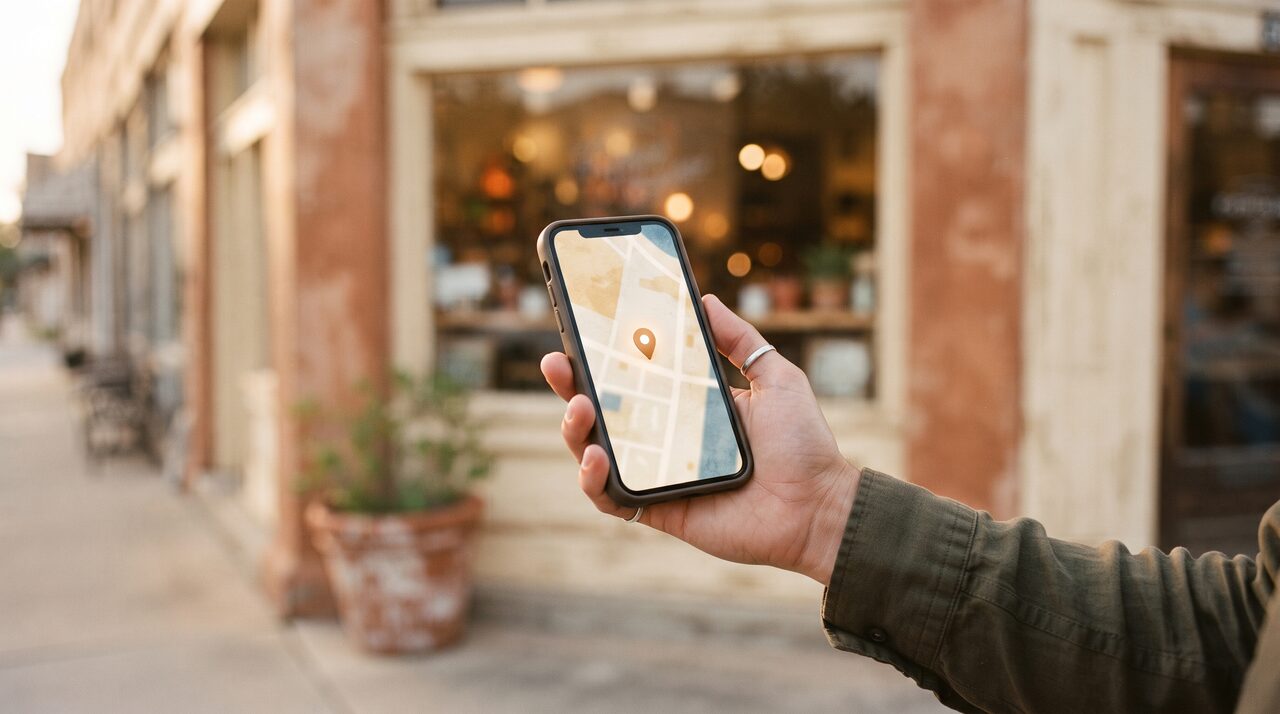
Drive down any Main Street and you can see who invested in their storefront. Fresh paint. A clean sign. A tidy window. It looks good, and it matters to the people walking by.
But here is the part you cannot see from the sidewalk. Before most of those customers ever walk by, they already made a decision on their phone. They searched. They read a few reviews. They looked at a map. And they picked where to spend their money before they ever left the house.
That means your community has a second storefront now. A digital one. And for most businesses in your town, that digital storefront is doing more to win or lose customers than the physical one ever could.
The front door moved
Think about the last time you tried a new restaurant, found a plumber, or looked for a gift shop. You probably did not drive around hoping to spot one. You searched, and you trusted what came back.
Your community's customers do the same thing. 97% of people read online reviews before visiting a local business (BrightLocal, 2026). If a business does not show up when people search, or shows up looking neglected, most shoppers move on without a second thought. The nicest awning in town cannot fix a business nobody can find.
A business that is invisible online is invisible, no matter how nice the building looks.
Invisible businesses are a community problem
When a local business does not show up online, that sale does not disappear. It goes somewhere else. It goes to the next town that ranks better, or to a national chain that spent the money to be found. Either way, the dollars leave your community.
Now multiply that by every under-the-radar business on your Main Street. A florist with no photos. A hardware store with the wrong hours listed. A great little taqueria with three reviews. Each one is leaking customers to competitors who are easier to find. Added up across a downtown, that is real money walking out of your local economy every single day.
The gap is bigger than most leaders think
This is not a small-tail problem. It is widespread, and it is fixable.
- 17% of small businesses still have no website at all (Clutch, 2025). Many more have a website that no one maintains.
- Even more have an incomplete Google Business Profile, which is the listing that actually decides whether they show up on Maps and in search.
- A complete profile makes a business 2.7 times more likely to be seen as reputable and earns 70% more visits, and profiles with photos get 42% more requests for directions (Google / Ipsos, 2016).
Read that again. The single biggest lever for many of your businesses is free, takes minutes, and most of them have not pulled it. Not because they do not care. Because no one showed them how, and no one is keeping score.
This is economic development, not marketing
It is easy to file "get online" under marketing and move on. That is a mistake. Being findable is infrastructure, the same way a sidewalk or a streetlight is infrastructure. It is the thing that lets commerce happen. And unlike a sidewalk, it costs almost nothing to build and it works around the clock.
It is also measurable, which is rare in economic development. You can score where every business stands today, help them improve, and re-score next month to prove it worked. Try doing that with a coat of paint.
The reframe: a facade program makes one building look good to the people already walking by. A digital facade program gets your whole community found by everyone searching, and you can measure the result.
What a community can actually do
The answer is not "tell businesses to try harder." Owners are busy running their shops. The answer is a simple, repeatable program that a community runs on their behalf:
- Score every business. Give each one a clear number that shows where they stand online today.
- Fix the gaps. Hand each owner a short, ranked to-do list and help them work through it.
- Track the progress. Keep one scoreboard for the whole community and re-check it every month.
That is exactly what Digital Facade does, and it is built to be run by the team you already have. Existing staff, a chamber ambassador, or an intern can own it. You bring the local relationships. The software does the heavy lifting.
Your businesses already have a digital storefront. The only question is whether anyone is taking care of it.
See where your community stands.
We will run a free snapshot of your downtown's online presence and show you the score, business by business.
Get a free community snapshot